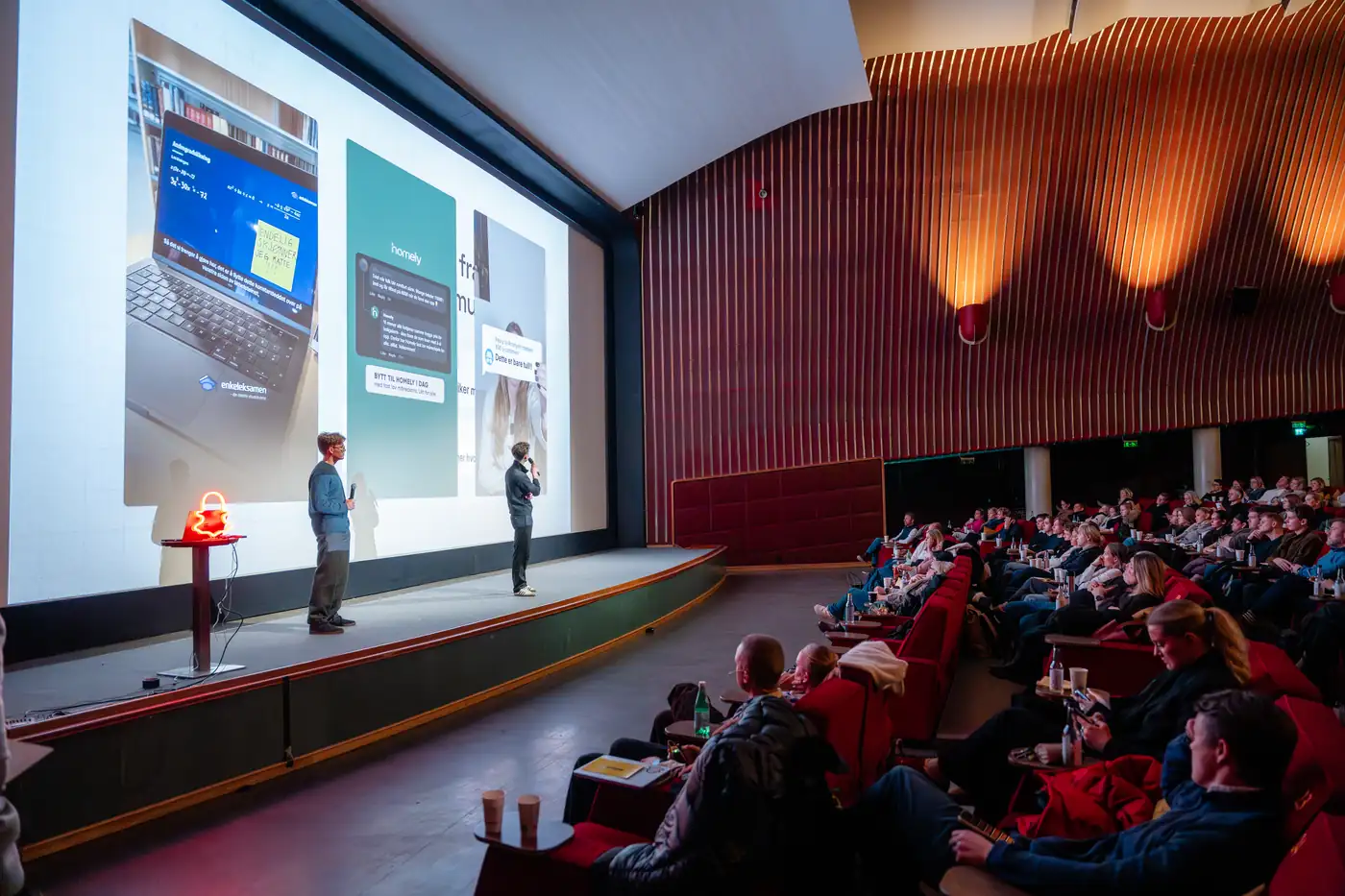
Most of what is written about street interview ads comes from people who have run a handful of shoots and are describing a novelty. We run them every week, across Norway, Sweden and Denmark, for 20+ brands, and the format stopped being a novelty for us a long time ago: it is an engine, with parts that can be tuned, worn out, and replaced. This is the operator's view of how that engine actually works.
What a street interview ad actually is, and why it converts
The mechanics are simple: an interviewer stops real people on the street and asks questions built around a brand's product. The honest, unpolished answers become the ad. No actors, no scripts, no second takes. What makes it work in a paid feed is the first second. Every scroller has developed reflexes against advertising: they recognize the studio lighting, the creator holding a product at chin height, the polished brand film, and they are gone before the value proposition ever loads. A real person mid-reaction does not trip that reflex, because it is not a pattern they have learned to skip. That is the entire trick, and it cannot be faked, which is precisely why it keeps working.
There is a second mechanism working underneath: social proof at scale. A street interview ad is not one person endorsing a product, it is a parade of strangers reacting to it. Viewers do the math themselves: if this many random people on a street in Oslo react like that, maybe there is something here. That inference is far more persuasive than any claim the brand could make in its own voice.
The economics: why volume is the real advantage
A typical UGC shoot gives you a handful of usable videos from one creator. One street shoot day gives you 40 or more unique ads, because every person interviewed is a new hook, and every answer can be cut into multiple angles and lengths. That difference compounds. In an algorithm that rewards creative volume over targeting precision, the account that ships 40 fresh ads a month simply learns faster than the account that ships four: more hooks tested, more losers killed early, more budget concentrated on proven winners.
A shoot day costs more than a single UGC video, because there are two people on location for a full day. But divide the day rate by 40+ usable ads and the cost per ad lands far below any other format we produce. In our accounts, street interviews typically outperform standard UGC by 2 to 3x on return for the same spend in cold-traffic prospecting. We broke the comparison down in detail in street interview ads vs UGC.
Planning: the question list is the strategy
Everything that matters is decided before anyone touches a camera. We start from the brand's angles, the actual reasons people buy, and turn each angle into questions designed to produce reactions rather than opinions. The craft is in the question type. Yes/no questions produce dead footage. Comparison questions ("which of these would you pay more for?"), guessing questions ("what do you think this costs?") and challenge questions ("try it right now") produce the surprise, laughter and blunt honesty that become hooks.
We pre-write the questions, never the answers. A good question list has 10 to 15 questions across 3 or 4 angles, so a single day feeds several distinct campaigns. Location matters less than people assume: you need steady foot traffic and tolerable audio, not a landmark. We shoot in Scandinavian cities of every size, and mid-sized towns often outperform capitals because people are less camera-worn and more willing to stop.
The shoot day and the edit
Our standard crew is deliberately small: one interviewer, one camera operator. Small crews read as harmless, and that changes what people give you on camera. A full day produces 60 to 100 interviews; roughly half contain something usable, and the best ten carry the month. The interviewer's job is not to sell, it is to listen and follow up, because the second answer is nearly always better than the first.
The edit is where discipline matters most, and the rule is counterintuitive: do less. Hooks first, always, the strongest reaction in the first second. Captions burned in, because most of the feed watches on mute. Cuts kept between 15 and 40 seconds, exported in every placement format. And the rawness stays in: street noise, imperfect framing, real pauses. Every pass of polish moves the ad closer to the brand film your audience has already learned to skip. Over-editing is the single most common way brands kill this format after buying it.
The three mistakes that kill the format
First, scripting. The moment you feed people lines, viewers feel it, and you have paid street-production prices for brand-film performance. Second, over-editing, covered above. Third, treating it as a one-off stunt: shooting once, celebrating the results, and stopping. Reactions age like any creative, and the format works as a weekly engine, not a campaign. The brands we scale with it, like Sneglefellen and Collagen for Hund, run it continuously, feeding fresh interviews into testing every single week.
Where it fits in your account
Street interviews are a prospecting format. They win attention from cold audiences who have never heard of you, which is the hardest and most expensive job in any account. Retargeting, product detail and offer-driven work still belong to other formats, so the healthy account runs street interviews at the top and lets UGC and statics finish the job further down. If you want the format without building the operation, that is literally what we do: see street interview ads at Curve, or Get in contact and we will show you real shoots and real numbers from accounts like yours.